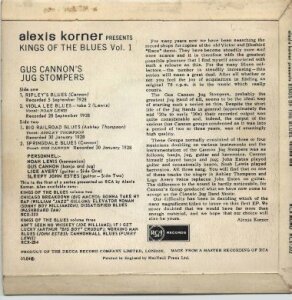
alexis korner presents KINGS OF THE BLUES
VOLUME ONE (RCX-202)



Sleeve photos by Alan Balfour
Side one
1. GUS CANNON'S JUG STOMPERS - Ripley's Blues (Lewis)
2. GUS CANNON'S JUG STOMPERS - Viola Lee Blues Take2 (Lewis)
Side two
1. GUS CANNON'S JUG STOMPERS - Big Railroad Blues (Lewis)
2. GUS CANNON'S JUG STOMPERS - Springdale Blues (Cannon)
Liner Notes by Alexis:
For many years now we have been searching the record shops for copies of the old Victor and Bluebird "Race" items. They have become steadily more and more scarce and it is therefore with the greatest possible pleasure that I find myself associated with such a release as this. For the many Blues collectors - the number is steadily increasing - this series will mean a great deal. After all whether or not you feel the joy of acquisition in finding an original 78 r.p.m. it is the music which really counts.
The Gus Cannon Jug Stompers, probably the greatest Jug Band of all, seems to be the ideal way of starting such a series as this. Despite the short life of the Jug Bands in general (approximately the mid '20s to early '30s) their recorded output was quite considerable and, indeed, the output of the various Gus Cannon groups condensed as it was into a period of two or three years, was of amazingly high quality.
These Groups normally consisted of three or four musicians doubling on various instruments and the instrumentation of the Cannon Jug Stompers was as follows; banjo, jug, guitar and harmonica. Cannon himself played banjo and jug; John Estes played guitar and occasionally kazoo, Noah Lewis played harmonica. All three sang. You will find that on one of these tracks the singer is Ashley Thompson and Lige Avery twice replaces John Estes on guitar. The difference to the sound is hardly noticeable, for Cannon's Group produced what we have now come to accept as the Classic Hug Band Music.
Our difficulty has been in deciding which of the many magnificent titles to issue on this first EP. We never doubted that we would have far more than enough material, and we hope that our choice will also be yours.
Alexis Korner
VOLUME TWO (RCX-203)


Side one
1. BIG MACEO - Chicago Breakdown (Maceo Merryweather) recorded 15 October 1945
2. WILLIAM "JAZZ" GILLUM - Gonna Take My Rap (Robert Brown) recorded 24 April 1947
Side two
1. SONNY BOY WILLIAMSON - Elevator Woman (Williamson) recorded 1939
2. WASHOBOARD SAM - Dissatisfied Blues (Robert Brown) recorded 1941
Liner Notes by Alexis:
It has always seemed somewhat arbitrary to divide the Blues into such categories as "Country" and "City". On the other hand, if one is trying to place these various songs in categories, for whatever purpose, it becomes necessary to be arbitrary. So volume two of KINGS OF THE BLUES is dedicated to four outstanding singers and players who functioned mainly in the Urban areas.
First, Maceo Merryweather. Maceo, a long time friend of Big Bill Broonzy, died of a stroke in the Winter of '53. He was working in Chicago where he had made an enormous reputation as one of the great Blues/Boogie pianists. Although he was also a singer of immense quality it seemed appropriate to represent him by his most famouse piano solo.
William "Jazz" Gillum is still around Chicago operating, so I understand from Paul Oliver, a furniture removal van. In his day he recorded prolifically for the Bluebird and Victor labels, and indeed, Big Maceo was one of his regular pianists. With a small yet penetrating voice and a strangely strangled harmonica style he succeeded in putting over with great presence the real feeling of the Blues. His pianist on this track, Eddie Boyd, is also still in Chicago.
It is unlikely that any singer and player since Lee Roy Carr exerted so much influence on the City Blues as did Sonny Boy Williamson. A native of Mississippi, Williamson came to Chicago in the late '30s. He made an enormous amount of records, most of them at an extraordinary high standard, and his harmonica playing set the pattern which has been followed by almost every Chicago player since. Of the many sides which he recorded Elevator Woman is one of the gayest and jauntiest that you are likely to hear. You will notice that in addition to the normal instrumentation there is also some very fine mandolin playing to be heard on this title.
Washboard Sam (Robert Brown) is Bog Bill Broonzy's half-brother. Despite this relationship Washboard Sam succeeded in evolving a very personal style with a broad, flowing delivery which places him amongst the very best singers of this music. A driving washboard player he imparts a very strong beat to the groups with whom he has recorded and Dissatisfied Blues which has Bill Broonzy on guitar and Josh Altheimer on piano is a fine example of a recorded Washboard Sam performance. Until a few months ago, when we last heard, Washboard Sam was living quietly in Chicago.
Alexis Korner
VOLUME THREE (RCX-204)

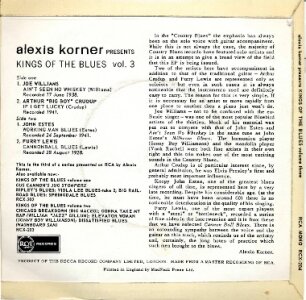


According a website (http://www.wirz.de/), this EP was released in 1962
Side one
1. JOE WILLIAMS - Ain't Seen No Whiskey (Williams)
2. ARTHUR "BIG BOY" CRUDUP - If I Get Lucky (Crudup)
Side two
1. JOHN ESTES - Working Man Blues (Estes)
2. FURRY LEWIS - Cannonball Blues (Lewis)
Liner Notes by Alexis:
In the "Country Blues" the emphasis has always been on the solo voice with guitar accompaniment. While this is not always the case, the majority of Country Blues records have featured solo artists and it is in an attempt to give a broad view of the field that this EP is being issued.
Two of the artists here have accompaniment in addition to that of the traditional guitar - Arthur Crudup and Furry Lewis are represented only as soloists - but even in such cases it is always noticeable that the instruments used are definitely easy to carry. The reason for this is very simple. If it is necessary for an artist to move rapidly from one place to another then a piano just won't do.
Joe Williams - not to be confused with the ex-Basie singer - was one of the most popular Bluebird artists of the thirties. Much of his material was put out to compete with that of John Estes and Ain't Seen No Whiskey is the same tune as John Estes's Milkcow Blues. The harmonica player (Sonny Boy Williamson) and the mandolin player (Yank Rachel) were both fine artists in their own right and this trio makes one of the most exciting sounds in the Country Blues.
Arthur Crudup is of particular interest since, by general admission, he was Elvis Presley's first and probably most important influence.
Sleepy John Estes, one of the greatest blues singer of all time, is represented here by a very late recording. Despite his considerable age. (at the time, he must have been around 60) there is no noticeable deterioration in the quality of his singing.
Furry Lewis, one of the most expert players with a "steel" or "bottleneck", recorded a series of fine sides in the late twenties and it is from these that we have selected Cannon Ball Blues. There is an astounding sympathy between the voice and the guitar on this track, which reminds us of the artistry and, certainly, the long hours of practice which such men brought to the blues.
Alexis Korner