Back cover of “Blues From The Roundhouse” Tempo Records EPs
This photo is from an inner sleeve of the limited re-issue edition of “Bootleg Him !” CD by Strange Days Record in Japan
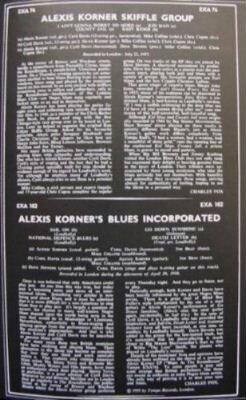
Alexis Korner Skiffle Group
“Blues From The Roundhouse Volume 1” (EXA76)

Sleeve photo from a website by Alan Pipes (http://www.geocities.com/fredpipes/blues.html)
Liner Notes by Charles Fox
At the corner of Brewer and Wardour streets, hardly a stonesthrow from Piccadilly Circus, stands the Roundhouse, a purple-brick Victorian publichouse. On a Thursday evening passers-by are sometimes startled to hear blues floating from its upstair windows, blues sung and played by the musicians heard on this record. In an area packed with skifflers strumming away in cellars and coffee-bars, only at the Roundhouse - headquarters of the London Blues Club – are Negro blues sung regularly and looked upon as an end in themselves.
Alexis Korner has been playing the guitar for eight years and collecting race records for double that time. In 1949, as a member of the Chris Barber Jazz Band, he played and sang with the first Chicago-style race group ever to be heard in London. Later he helped to organize the original Ken Colyer Skiffle Group. Asked for his favourite guitarists, Alexis picks Scrapper Blackwell and Charlie Christian; the singers he likes the best are Sleepy John Estes, Blind Lemon Jefferson, Brownie McGhee and Joe Turner.
Not many British guitarists have succeeded in playing blues with sympathy and understanding. One who has is Alexis Korner, another Cyril Davis. Cyril’s style of singing and the fact that he had a 12-string guitar specially built for him should be evidence enough of his regard for Leadbelly’s work. Yet although he employs many of Leadbelly’s phrases, Cyril always tries to use them in a personal manner.
Mike Collins, a civil servant and expert linguist, and 17-year-old Chris Capon complete the regular group. On two tracks of the EP they are joined by Dave Stevens. A chartered accountant by profession, Dave has been active as a pianist over the past eleven years, playing both jazz and blues with a variety of groups. His favourite pianists are Earl Hines and the late Cripple Clarence Lofton.
That great singer of country blues, Sleepy John Estes, recorded I Ain’t Gonna Worry No More in 1937; many of his cadences can be discerned in Alexis Korner’s interpretation. Easy Rider, a traditional blues, is best-known in Leadbelly’s version. “If I was a catfish swimming in the deep blue sea I’d have all you women diving after me” runs one stanza of this half-sorrowful, half-boastful song.
Although Kid Man and Country Jail were originally recorded in 1944 by Big Maceo Merriweather, Dave Stevens’ piano playing on these tracks is entirely different from Maceo’s, just as Alexis Korner’s guitar work differs completely from Tampa Red’s. “I had a woman, had a woman, had a mouthful of shiny gold,” runs the opening line of the exuberant Kid Man. Country Jail, a prison blues, is graver in mood and pattern.
When Big Bill Broonzy and Jimmy Rushing visited the London Blues Club they not only sang but expressed their delight at hearing genuine blues in the heart of London. Their tributes were appreciated by these young musicians, who take the blues seriously but not themselves. With humility and sympathy they re-creat these songs, striving always for authenticity of feeling, hoping to use the idiom in a personal way.
Charles Fox
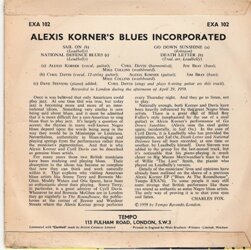
Alexis Korner’s Blues Incorporated
“Blues From The Roundhouse Volume 2” (EXA102)

sleeve photos courtesy by BARACCHI GIANLUIGI from Lodi, Italy
Tracks:
Sail On (Leadbelly)
National Defence Blues (Leadbelly)
Go Down Sunshine (Johnson)
Death Letter (Trad.arr. Leadbelly)
Alexis Korner: vocals (‘Go Down Sunshine’), acoustic guitar
Cyril Davies: vocals/acoustic guitar (except for ‘Go Down Sunshine’), harmonica (‘Go Down Sunshine’)
Jim Bray: string bass
Dave Stevens: piano (‘National Defence Blues’)
Mike Collins: washboard
Recorded: Decca West Hampstead Studios, London, April 29 1958
Produced by Geoff Milne
Released: December 1958 (Tempo EP, EXA 102)
Liner Notes by Charles Fox
Once is was believed that only Americans could play jazz. At one time this was true, but today jazz is becoming more and more of an international idiom. Something very similar is now being said about blues, and it must be admitted that it is more difficult for a non-American to sing blues than to play jazz. It’s largely a question of accent; the rhymes in many well-known Negro blues depend upon the words being sung in the way they would be in Mississippi or Louisiana. Nevertheless, authenticity in blues-singing and playing springs from the performance rather than the musician’s pigmentation. And that is why Alexis Korner and Cyril Davis can be described as genuine blues artists.
For many years these two British musicians have been studying and playing blues. Their absorption in the idiom has become so complete that now they can think and work naturally within it. That explains why visiting American blues artists like Sonny Terry and Brownie McGhee, Muddy Waters and Otis Spann, have been so enthusiastic about their playing. Sonny Terry, in particular, is a great admire of Cyril Davis. Whenever he and Brownie McGhee are in London they go regularly to the Roundhouse, the publichouse at the corner of Brewer and Wardour Streets where the Alexis Korner group performs every Thursday night. And they go to listen, not to play.
Naturally enough, both Korner and Davis have been heavily influenced by the great Negro blues artists. There is a great deal of Blind Boy Fuller’s style (emphasized by the use of a steel guitar) in Alexis Korner’s performance of Go Down Sunshine. (Alexis uses the steel guitar again, incidentally, in Sail On.) In the case of Cyril Davis, it is Leadbelly who had provided the inspiration, and Sail On, Death Letter and National Defence have all been recorded, at one time or another, by Leadbelly himself. Dave Stevens was added to the group for the last-named track, but it’s noticeable that his piano-playing is much closer to Big Maceo Merriweather’s than to that of Willie “The Lion” Smith, the pianist who played on Leadbelly’s version.
Details of the musicians’ lives and opinions have already been outlined on the sleeve of a previous Alexis Korner EP (“Blues At The Roundhouse”, Tempo EXA76). To some people it may still seem strange that British performers like these can sound as authentic as some Negro blues artists. The only way of proving it is to shut your eyes and listen.
Charles Fox
"Sail On" is also here and "Go Down Sunshine" is here.